
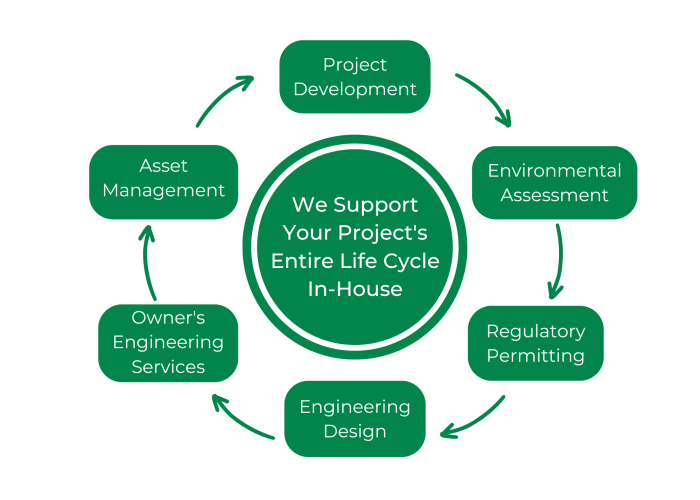
With 15+ years in the renewable energy industry, GCR has developed extensive experience in greenfield project development. We have a comprehensive understanding of the technical and environmental considerations involved with the development of renewable energy and storage projects. Our team is highly adept in navigating constraints to provide reliable and meaningful site selection recommendations to our clients.
Our Project Development service offering, and experience, underpin our key service offerings in Permitting and Engineering and allow GCR to provide a full “wrap around” development service for renewable and power generation projects. These services include:

The first step in the development of any renewable, or power generation, project is conducting a feasibility assessment to analyze project viability and gain an understanding of development risk. Drawing on our full range of in-house capabilities, GCR produce and deliver comprehensive studies, customized to individual client requirements.
A feasibility assessment would generally include the following:
● Initial concept design and technology review, including recommendations on layout, scale and infrastructure design;
● Consideration and mapping of the key environmental and technical constraints (to ‘flag’ any potential concerns) and making recommendations for further work to manage risk, where necessary;
● Project constructability review;
● Interconnection options and grid connection feasibility review;
● Initial resource and energy yield estimate; and
● Permitting strategy and advice.
The feasibility assessment clearly identifies a proposed plan for the development of the project, which allows our clients to make strategic decisions with regards to progressing the project to the next stage.

The design and optimization of a renewable or power generation project is generally an iterative process. This process utilizes the results of site-specific environmental assessment work, GIS constraints mapping, observations from site visits and site investigation, a constructability review, stakeholder and regulatory authority input, public engagement, input from the technology provider and the resource of the site. GCR have experience designing unique sites with varying capacity, topography, climate and environmental concerns. As a result, we have hands-on experience in dealing with, and finding solutions for, a wide range of often complex environmental, technical and engineering constraints.

As an engineering consultancy specializing in renewable development, GCR utilize industry knowledge and technical capabilities to assist our clients in the selection of appropriate technology solutions for their projects. We are experienced in technology selection for wind, solar, hydro and BESS projects. services. For more information please refer to our Technical Procurement services.

Renewable energy from wind, solar and hydro are inherently affected by the frequency, intensity and variability of the basic energy resource. As intermittent sources of energy, dependent upon local weather patterns and seasonal variability, robust and bankable resource assessments form the backbone to every renewable energy project.
Our technical analysts are well versed in wind, solar and hydro resource assessments, applying industry accepted statistical methodologies to both measured and modelled data, to develop realistic resource projections for specific site locations. Specialist software packages are used to inform our assessments, which include PVSyst, Openwind, Windographer, WindFarm, RETScreen, LowFlows, amongst others.
A robust resource assessment enables sensible energy yield forecasts to be derived, considering technology specifications and the effects of ancillary infrastructure. These form the basis for projecting key investment metrics, such as P50, P90 and P99 energy yield estimates over the commercial lifetime of a project.

GCR support grid interconnections across all types of energy generation projects. Our team of electrical engineers and grid specialists provide technical expertise and advice on all electrical aspects of the project, from initial feasibility to commercial operation (COD). At the initial feasibility stage our team are able to provide strategy and advice for locating generation projects (based on our knowledge and understanding of the grid networks), advise our clients on potential competing capacity, assist in navigating the interconnection process, and lead discussions with the network operators to progress the project.
As more variable generation is introduced onto the grid, the management of networks becomes more complex. GCR work with the various network operators to provide innovative and flexible grid solutions, such as Active Network Management, for connecting renewable generation. On the technology side, GCR is also actively involved in hybrid generation, combining renewables such as wind and solar, or combining renewables with storage, or non-renewable generation, to ‘level out’ the variable generation profile when renewable projects are independent and isolated.

A key aspect of the development of any renewable energy or power generation project is navigating the permitting process. The permitting process will follow guidance and legislation laid out at the Federal, Provincial/State and Municipal levels. To ensure project success, it is vital to have a comprehensive understanding of the requirements and how these may impact project size, location and type. The GCR team have significant expertise in providing project specific permitting strategy advice, which is tailored to the needs of our clients. For further details please refer to our Permitting services above.

GCR provides due diligence technical services to both prospective private equity investors and lenders alike, for renewable energy and power generation projects. GCR utilize “on-the-ground” experience to analyze renewable energy and power generation proposals at pre-construction and operational phases, as well as completing construction stage monitoring for our clients.
Our due diligence reviews are tailored to the needs of the investor or lender, with risks and issues analyzed to reflect the needs and priorities for a broad range of stakeholders, including the long-term equity investor, senior debt and subordinate debt providers.
Typical subjects covered in our due diligence reviews may include:
● Regulatory Compliance;
● Environmental features (affecting long term operation and generation);
● Resource Analysis reviews (wind, solar and hydro including hydrological analysis);
● Geotechnical reviews;
● Environmental conditions (including existing infrastructure, flood risk, ground resistivity, third party interests);
● Operational Performance Analysis (including energy performance and facility availability);
● Technical contract review including contracts for wind (such as TSA, MSA, EPK, Balance of Plant), solar (EPC), hydro (equipment procurement, Design & Build), Grid Interconnection Agreements and land leases/Right-of-Way agreements;
● Electrical engineering design review;
● Construction schedule review;
● Technical CAPEX, OPEX and DEVEX review;
● Offtake agreements & PPA’s;
● Validation of acceptance and compliance test results for solar power installations;
● Portfolio Analysis;
● Technical oversight of construction and testing; and
● Independent Punch List.

Diligent asset management of operational projects ensures project assets are regularly maintained, and faults are rapidly rectified. In turn, the availability of a site can be maximized, resulting in increased revenue generation for the investor.
GCR provides asset management services to utility scale solar and wind projects. The scope of services is adapted to individual projects and asset owners, who may have differing monitoring and reporting requirements to satisfy company boards, shareholders and debt providers.
Our Facility Management services include:
● SCADA monitoring;
● Monthly, quarterly and annual performance reporting;
● Troubleshooting;
● Management of O&M providers, landowners and project stakeholders;
● Routine Asset Inspections;
● Compliance Monitoring; and
● Project Administration

At GCR, we conduct comprehensive wildlife and habitat surveys tailored to your project’s needs. Our experienced team can identify species and ecosystems within your project area, with a focus on sensitive wildlife and habitats. Using proven methodologies, we complete surveys to support regulatory compliance, minimize and mitigate environmental impacts, and promote sustainable project development.
Our services include in-depth analyses of survey results, detailed reporting, and an evaluation of wildlife populations and seasonal activity patterns. This enables us to support project siting and develop regulatory permitting strategies to reduce permitting risk.
Whether your project is in the pre-development, construction, or post construction phase, we provide the expertise needed to assess and manage wildlife considerations at every stage, helping to inform decisions and mitigation strategies throughout the project lifecycle.

GCR provides Environmental Assessment (EA) services across Canada to support the regulatory permitting of renewable energy projects. Our expert team of experienced
professionals conduct comprehensive assessments to evaluate potential environmental impacts on ecosystems, including flora, fauna, water resources, soils and terrain, agricultural and sensitive habitats. We identify valued components relevant to the project, ensuring key environmental factors are considered. By assessing risks early in project planning, we develop science-based mitigation strategies to minimize environmental effects and ensure compliance
with provincial and, where applicable, federal regulations. Our extensive experience across multiple regions and with multiple projects allows us to remain current on regulatory requirements
and develop tailored strategies to support permitting efficiency.
Our Environmental Assessment and Regulatory Support services include:
● Environmental Impact Assessments (EIAs) to evaluate project effects and inform mitigation strategies.
● Environmental Management Plans (EMPs) to guide environmental protection during construction, operation, decommissioning, and reclamation.
● Conservation and Reclamation (C&R) Plans to establish baseline site conditions and outline post-operation restoration strategies.
● Agricultural Impact Assessments and Agrivoltaics Planning to assess land-use compatibility and develop strategies for integrating renewable energy with agricultural production.
● Regulatory submissions and compliance reporting to meet federal, provincial, and municipal environmental requirements.

Our team provides expert environmental support to development teams and senior leadership, helping to identify risks, optimize strategies, to support regulatory compliance. We conduct due diligence reviews and third-party assessments of environmental data to evaluate project
feasibility and permitting risks. Our strategic approach helps clients navigate environmental regulations, anticipate potential challenges, and implement proactive solutions to mitigate
operational costs and liabilities.
Our Develop Team and Senior Strategy services include:
● Due diligence reports that include comprehensive environmental reviews to assess potential risks and regulatory considerations prior to project development or to support project
acquisitions.
● Third-party reviews of environmental information and data, providing an independent assessment of potential concerns, permitting risks, and opportunities for project optimization.
● Senior strategy support by identifying environmental constraints, jurisdictional requirements, and permitting challenges, helping clients navigate complex regulatory landscapes.
● Contingency planning and keeping clients informed of regulatory changes, environmental requirements, and legislation that may impact project feasibility. By integrating environmental considerations into project planning and decision-making, we help clients minimize risks, reduce costs, and enhance project success.

Understanding environmental constraints early in project planning is key to reducing risks and streamlining regulatory approvals. Our team conducts comprehensive environmental feasibility
assessments to pinpoint potential challenges related to land use, wildlife, and regulatory requirements. As part of this process, we perform desktop environmental screening to identify
potential risks and constraints, including delineated and classified wetlands, sensitive habitats, and species at risk screening.
Our environmental constraints assessment includes evaluating species ranges, critical habitats, and determining the likelihood of species at risk being present within the project area. By assessing site conditions and constraints upfront, we provide clients with a clearer picture of environmental considerations, supporting informed decision-making and project optimization.

Environmental construction monitoring helps projects maintain compliance with environmental regulations and standards, minimizing impacts on local ecosystems. Our experienced team conducts assessments to identify key environmental components requiring monitoring and
develops Environmental Management Plans (EMPs) that outline site-specific protection
measures and best management practices (BMPs) throughout the construction, operation, and decommissioning processes.
We monitor a variety of environmental parameters during construction, including implementing the project-specific EMP, erosion and sediment control, conduct wildlife and nest sweeps, and oversee the protection of sensitive species and habitats. With extensive experience in
environmental monitoring, we take a proactive approach to real-time monitoring, supporting adherence to regional, provincial, and federal regulations while identifying and addressing environmental issues early to minimize potential impacts on timelines and regulatory approvals.
Our team also provides detailed environmental reporting to document compliance and support regulatory submissions. Additionally, we integrate industry best practices into all aspects of
monitoring and reporting to ensure projects meet the highest environmental standards.

We provide post-construction environmental services to support continued regulatory compliance
and assess the ongoing impacts of the project on the environment. Our team offers wildlife mortality monitoring programs, which include field data collection, analysis, and reporting. We
monitor wildlife fatalities, particularly for species like bats and birds, to evaluate project effects and determine whether additional mitigation measures are necessary. Our team of experts relies
on extensive experience to develop and implement alternative mitigation plans to support project operations and navigate compliance concerns.
GCR has the expertise to develop and implement curtailment strategies to reduce wildlife impacts, such as adjusting operational practices or schedules, and assessing their effectiveness over time. Our post-construction reporting ensures clear documentation of monitoring results to regulators and any recommendations for further action, helping maintain regulatory compliance and supporting the long-term sustainability of your project.

Our team ensures that environmental commitments are adhered to throughout the project’s lifecycle, from the initial stages of project inception to final reclamation. We monitor compliance
with regulatory requirements, develop mitigation strategies, and address potential issues that may arise.
We provide ongoing regulatory engagement to stay aligned with environmental requirements and respond to any compliance concerns. Our team also develops and implements additional mitigation measures to address emerging issues or regulatory changes. We regularly update environmental plans to reflect new or evolving environmental considerations and project needs. Additionally, we ensure environmental commitments are effectively followed through, mitigating risks and addressing any unforeseen impacts.
Our goal is to proactively manage environmental compliance, reduce risks, and ensure that all environmental aspects of the project remain in line with established environmental standards.

Our conservation and reclamation support services focus on restoring and rehabilitating ecosystem impacts. We provide site and desktop assessments at the permitting stage to establish baseline conditions, including soils, sensitive features, and existing land use. Our team
is experienced in developing Conservation and Reclamation Plans (C&R Plans) that outline industry standard best practices and mitigation measures to minimize environmental disturbance and guiding the land back to pre-disturbance conditions. We also offer reclamation site assessments, including interim reclamation evaluations, to measure restoration success and ensure compliance with regulatory requirements.
Our comprehensive support services include reclamation planning, soil and vegetation assessments, monitoring, and regulatory reporting. We align all reclamation efforts with provincial reclamation directives and requirements. From planning to implementation, we offer
expert guidance at every stage of the reclamation process to help meet environmental commitments and achieve long-term sustainability.

Navigating the regulatory approval process can sometimes involve public hearings, open houses, legal proceedings, or regulatory consultations. Our team has extensive experience providing
regulatory hearing and subject matter expert witness support to guide clients through these complex stages. We provide the necessary scientific, technical, and environmental expertise during hearings and proceedings, offering expert testimony and strategy on a wide range of
environmental issues associated with renewable projects.
Beyond testimony, we assist in preparing materials for hearings, responding to regulatory inquiries and information requests, and addressing stakeholder concerns. Our team is well-versed in interpreting regulatory requirements, preparing and submitting regulatory applications, and engaging with regulatory agencies to facilitate project approvals. Relying on our other service areas, we offer our clients a wide breadth of complete support to navigate the entire regulatory process. With in-depth knowledge of federal, provincial, and municipal frameworks, we help our clients navigate regulatory processes efficiently.
● Planning Strategy and Policy Advice;
● Application Coordination and Reporting;
● Permitting Management;
● Project Extensions, Amendments and Re-Powering Applications;
● Environmental Assessment Co-ordination;
● Permitting Appeals;
● Expert Witness Services and Hearing Support;
● Permit Compliance and Condition Amendments;
● Stakeholder and Public Engagement;
● Production of Technical Studies; and
● Project Management.

Our broad understanding of permitting requirements and environmental constraints for renewable and alternative energy projects enable the GCR team to quickly find effective solutions to manage and mitigate project development risk.
● Planning Strategy and Policy Advice;
● Application Coordination and Reporting;
● Permitting Management;
● Project Extensions, Amendments and Re-Powering Applications;
● Environmental Assessment Co-ordination;
● Permitting Appeals;
● Expert Witness Services and Hearing Support;
● Permit Compliance and Condition Amendments;
● Stakeholder and Public Engagement;
● Production of Technical Studies; and
● Project Management.

GCR have a dedicated team of noise consultants to support clients with the delivery of wind, solar and battery energy storage projects throughout the permitting phase. In addition, we can provide ongoing technical support and compliance noise monitoring through the operational phases.
GCR’s capabilities include:
● Noise impact assessments (NIA’s) to support regulatory approvals in line with ISO 9613:2;
● Expert witness testimony;
● Measurement of third party energy related facility sound power levels;
● Identification of faults using noise measurement equipment;
● Construction noise assessments;
● Compliance measurement and assessments;
● Designing noise insulation solutions for equipment enclosures;
● Assessment of amplitude modulation for wind turbines (using audio recording for noise source validation);
● Noise mitigation design, involving liaising with wind turbine manufacturers;
● Peer review of noise studies.

Glint and glare refers to the reflection of the sun’s light from the surface of an object into an observers eye. Glare has the potential to impact stakeholders and increase the risk associated with operators performing regular daily tasks, and/or causing an irritation. Impacts associated with solar glare can be a regulatory consideration for conventional photovoltaic solar arrays and centralized solar power plants.
Our core competencies include:
● Assessment of glare on residences, roads, and aviation assets (including control towers, airplanes and helicopters);
● Expert witness testimony;
● Production of Solar Glare Hazard Assessments concurrent with applicable legislation;
● Regulatory advice surrounding glare impacts (in light of relevant jurisdictional regulations);
● Evaluation of mitigation options to achieve regulatory compliance or eliminate glare
● Peer review of third-party glare assessments.

GCR’s team of landscape consultants complete visual renderings of renewable energy projects to current standards and best practices using the latest software and technology. Subject to client needs, GCR complete visualizations using a range of full-frame digital camera images, GIS mapping, ReSoft Windfarm, WindPRO and augmented reality, real-time, visualization software (Ventus AR).
Our Landscape Consultants are experienced in the service offerings below:
● Visualization production;
● Landscape and Visual Impact Assessment;
● Cumulative Landscape and Visual Impact Assessment;
● Residential Visual Amenity Assessment (RVAS);
● In-house Landscape Photography;
● Augmented reality, real-time, visualizations, utilized in support of stakeholder engagement.

Wind turbines have the potential to cast shadows over large areas. Where these shadows cross windows, into enclosed spaces, there is a risk of the spinning rotor causing a fluctuation in light levels, which is called shadow flicker. As part of the permitting of wind energy projects, regulators typically require the submission of a shadow flicker assessment.
GCR’s service offering relating to shadow flicker includes:
● Assessment of theoretical and real case shadow flicker impacts on receptors, including dwellings and workplaces;
● Evaluation of turbine layout optimization to minimize impacts;
● Jurisdictional and software reviews to support regulators considering changing or revising legislation;
● Development of shut-down scheduling to ensure thresholds are not breached.

The appropriate identification of stakeholders and a comprehensive engagement strategy are critical to the successful development of energy projects. Our business originated to serve distribution scale projects (local and community owned) where public engagement is central to the success of each project. GCR’s in-depth understanding of jurisdictional regulatory requirements bring significant experience in public consultation and community engagement across distribution and transmissions scale energy projects. GCR’s core services include:
● Strategic development of a stakeholder engagement process;
● Management, co-ordination and execution of a stakeholder engagement process;
● Production of stakeholder engagement and participant involvement reports;
● Stakeholder identification, line list creation, and associated mapping;
● “Open House” strategy, organization and execution;
● Development and distribution of a project information package;
● Personalized one-on-one consultation;
● Agency consultation;
● Administration and review of communication registers.
GCR have strategic alignments with licensed land agents and support clients with land acquisition when requested.
We also produce specialist visualizations of development projects, inclusive of utilizing real-time imaging to help stakeholders conceptualize how projects will appear once operational.

With experience on over 500 energy projects to date, GCR thoroughly understands the many risks associated with energy projects, including the appropriate response measures to mitigate risks, in the event of emergencies. GCR’s Emergency Response Plans (ERP’s) support project permitting and stakeholder engagement, establishing key processes to be followed by contractors and operators during the later stages of project development and construction and also during operation.
Our ERP’s are site and jurisdiction specific and include procedures for managing risk related to:
● General emergency response and evacuation;
● Medical emergency;
● Fire response;
● Pollution release and hazardous materials;
● Vehicle or transport;
● Severe weather;
● Project specific concerns.
Procedures are packaged in a formal report, alongside key project and key contact information, to support regulatory and stakeholder engagement. ERP’s also form the baseline for the construction and operational emergency response procedures, produced by the contractor and operator.

Plans for the decommissioning of renewable energy projects are often requested from developers, by municipal or provincial regulators and/or landowners, during project permitting and lease discussions.
The GCR team have experience in preparing decommissioning plans concurrent with local guidelines. Each plan is tailored to project needs, jurisdictional requirements and includes:
● Key project details;
● Regulatory requirements;
● Reinstatement of temporary works;
● Decommissioning commitments and process;
● High-level schedule.

Our team of energy experts have experience supporting a range of energy projects through regulatory hearing procedures, which includes providing impartial testimony at quasi-judicial proceedings. Our hearing experience includes wind, solar and battery energy storage development, where our experts have provided testimony related to specialized aspects of project development.

The GCR team have experience conducting air quality modeling for conventional energy generation and other business activities (agricultural production). We follow local guidelines and regulations, relating to various jurisdictions and conducting Air Quality Dispersion Modeling, utilizing the United States Environmental Protection Agency’s (EPA’s) AERMOD integrated atmospheric dispersion modeling software.
We have strategic partnerships and alignments with third party consultants who conduct both onsite and ambient air quality measurements to support assessments.

Our team have experience with the assessment of Green House Gas (GHG) emissions associated with a range of projects and technologies. GCR conduct assessments of both directly attributed and upstream activities. Our assessments are tailored to the local jurisdiction and are typically quantitative in nature. We also provide commentary on the assessment findings relative to jurisdictional targets and thresholds.
GCR are aligned with consultants that deliver GHG verification in line with ISO 14065 and hold ANSI – Accredited Greenhouse Gas Verification Body status.
Please contact GCR to learn how we can assist with a professional and independent review of your projects
We focus primarily on wind, solar, energy storage and hydro energy projects, but also support conventional power generation and heavy industrial projects. Our capabilities cover a complete project lifecycle, from concept and early design stage feasibility, to preliminary engineering (DBM, FEED and EDS) throughout Detail Engineering, construction, pre-commissioning and commissioning support. We have extensive experience with the design and optimization of renewable energy systems in both, standalone and hybrid projects. Our goal is to add value to our clients with customized and practical design solutions for the specific location, environment and scale.

Our in-house grid team have a broad range of experience across all types of renewable and conventional generation projects in multiple jurisdictions (North America and Europe). We are available to provide technical expertise and advice on all aspects of the project interconnection process including:
● Initial grid feasibility;
● Grid connection application process management;
● Review of connection agreements;
● Grid interconnection interface design drawings, electrical specifications, protection and control settings and coordination; and;
● Liaison with transmission and distribution network owners/operators.

We provide clients with full design drawing packages, fully customized to your project requirements. We conduct, manage and review drafting (CAD) tasks and Swept Path Analysis for projects, as well as managing document and drawing registers.

We have strategic partnerships with experienced industry professionals to complete all scopes of engineering design related to renewable energy projects.
Please contact GCR to learn how we can assist with a professional and independent review of your projects.

We provide our clients with detailed civil designs throughout all stages of project development. We have extensive experience in unique and challenging environments, including the Arctic and numerous remote islands.

We provide our clients with project layouts and site designs, throughout the development process. With CAD and GIS software, we customize the layout to our client’s needs, utilizing publicly available data and mapping resources to optimize the layout. As the project progresses through the design lifecycle, additional details and design features are added to satisfy the overall development process.

We have the electrical engineering capabilities and experience to provide design and engineering support across all types of energy projects. Our team of electrical engineers and grid specialists provide technical expertise and advice on all electrical aspects of the project from initial feasibility to commercial operation, including:
● Electrical drawings and layouts;
● Single Line Protection and Metering Diagrams;
● Power system modelling, simulation and studies, including: short circuit, protection setting and coordination, arc flash studies and labels, power flow, motor starting and dynamic stability, harmonic analysis, grounding studies and electrical grid compliance studies;
● Relay setting files / setting sheets;
● Collector system design optimization;
● Electrical layouts: equipment arrangement, cabling, grounding, lighting and small power, area classification;
● Electrical drawings: interconnection and wiring diagrams, electrical schematics, electrical/control interface drawings, electrical installation details;
● Electrical schedules: cable schedule, panel schedule, electrical equipment list;
● Load studies / analysis;
● Electrical equipment sizing (transformers, generators, switchgear / MCC);
● Electrical design basis / criteria;
● Equipment specification and data sheets;
● Material requisitions for quotation / purchase / technical evaluation / vendor drawings review;
● Electrical Material Take-Off; and
● Engineering and construction work packages.
● Field verification and investigation reports of root cause analysis and solutions for persistent equipment failures, nuisance tripping problems and power system integrity.
● Technical evaluation and procurement of new electrical equipment and modified/retrofitted custom-made designs of existing equipment

The process of optimizing a design is an iterative one, which utilizes the results of site-specific environmental assessment work, GIS constraints mapping, observations from site visits, constructability, stakeholder and regulatory authority input, public engagement, input from the technology provider and the resource of the site.
We bring 15+ years of renewable energy expertise and experience to your project and provide the following services to our clients in North America and Europe.

● Project coordination and management;
● Interface Management;
● Contractor Management;
● Stakeholder Management;
● Conflict Resolution Management;
● Risk Mitigation & Management; and
● Third-party relationship management.

Preliminary Design
● Starting with civil and electrical conceptual designs, to array layout options, GCR’s engineering team provide detailed insights based on site specific conditions and previous project experience
● Design Management
● Services include the technical review and management of various disciplines including civil, electrical, structural and geotechnical designs.

Equipment Procurement
● Starting with the procurement of technology, all the way to Balance of Plant (BoP) procurement, GCR support clients with the tendering process and development of technical documents, alongside legal advisors.
Contracting Strategy
● Every project is unique, with specific constraints and risks, warranting a carefully thought-out contracting strategy to balance risk mitigation, ensuring safety and optimizing financial gains. GCR have extensive experience delivering projects in a variety of contracting arrangements and support our clients in selecting the best contracting strategy for their project.

Contract Management
● GCR coordinate BoP activities, including the execution of procurement, equipment inspection, transport, installation, commissioning and testing, while ensuring project safety and quality for our clients
Schedule Management
● GCR provide support in developing, delivering and maintaining the project’s master schedule, alongside the project execution plan.
Budget Management
● GCR will manage your project budget, ranging from payment assessments, tracking the overall budget, as well as dealing with change orders and compensation events.
Construction Supervision
● GCR provide on-site, field supervision support for our clients. We tailor our scope offering to each client’s specific needs for on-site support. Typical scope includes: QA/QC inspections, progress reports/management, audits and inspections of key phases of work as well as the monitoring of the health and safety activities.

GCR understand that every energy project is unique and will have varying reporting and inspection requirements. As Independent Engineer and/or Technical Advisor, our role is tailored to the requirements of the investor and/or developer. GCR’s team of engineers and technical specialists complete independent analysis, reviews and inspections during all stages of project development, design and construction. GCR’s services include, but are not limited to, the following:
● Third party civil and electrical engineering design reviews
● Tender package creation, management and RFP response reviews
● Contractual technical reviews
● Independent site inspections and reporting
● QA/QC reviews
Please contact GCR to learn how we can assist with a professional and independent review of your projects.